Researcher: Andre Sealy
Introduction
An equal-weight portfolio gives every asset the same allocation and provides a simple benchmark for portfolio construction. This project tests whether reinforcement learning can improve on equal weighting across market regimes when trading frictions are included.
Methodology
The study compared Decision Transformers with and without macroeconomic regime inputs against an equal-weight portfolio. The regime-aware models used GDP, oil prices, and unemployment, individually or in combination. The analysis considered transaction costs, market impact, and turnover constraints.
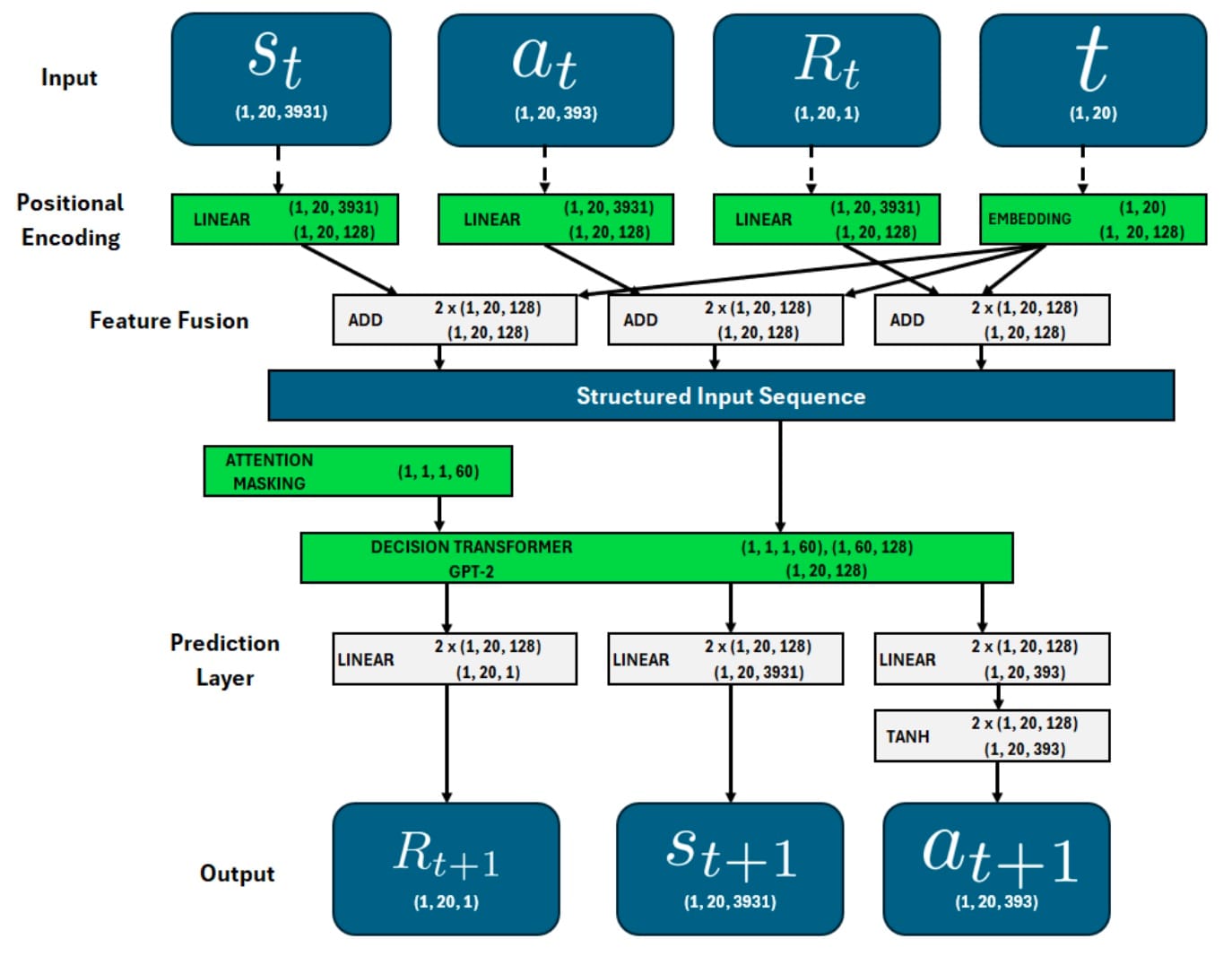
Figure 3 shows how the baseline Decision Transformer uses history to make a portfolio decision. It encodes past states, actions, returns, and time steps as a sequence. The attention mechanism lets the model give earlier observations different weights when predicting the next action. This architecture provides the reference point for testing whether macroeconomic regime information improves portfolio performance.
Results & Analysis
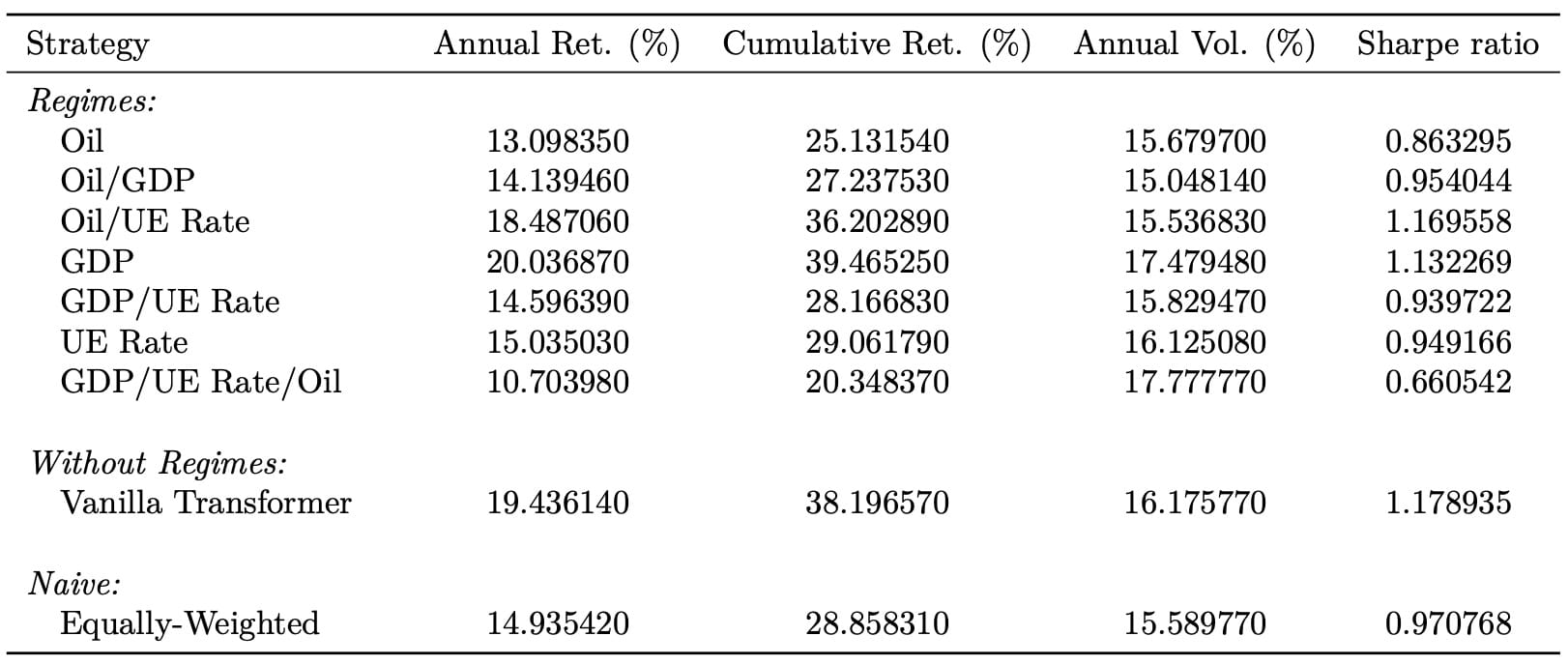
The baseline Decision Transformer had the highest Sharpe ratio at 1.18, compared with 0.97 for equal weighting. The GDP-only model had the highest annualized return at 20.04%, but its higher volatility left it with a lower Sharpe ratio than the baseline.
The model using GDP, unemployment, and oil together had a Sharpe ratio of 0.66. Some regime inputs helped on particular measures, but the model with all three inputs lagged the benchmark on risk-adjusted performance.
Conclusion
Several Decision Transformer variants improved on equal weighting in the reported comparison, but the results varied with the inputs and the performance measure. The equal-weight portfolio remains a useful benchmark for judging whether the gains from added model complexity justify the trading it generates.