Researcher: Nicholas Masi
Faculty Advisor: Dr. Dragos Bozdog
Introduction
Analyst consensus is a common starting point for forecasting earnings per share (EPS). A consensus average gives each estimate the same weight. This project asks whether reweighting information from I/B/E/S can improve forecast accuracy and whether the best approach varies across sectors.
Methodology
The study compared the consensus benchmark with a weighted forecast, LASSO, Elastic Net, Random Forest, and XGBoost. It evaluated the models on training and test data for both the combined sample and separate sector groupings. Mean absolute error (MAE) measures the average size of a forecast miss. Root mean squared error (RMSE) gives larger misses more weight.
Results & Analysis
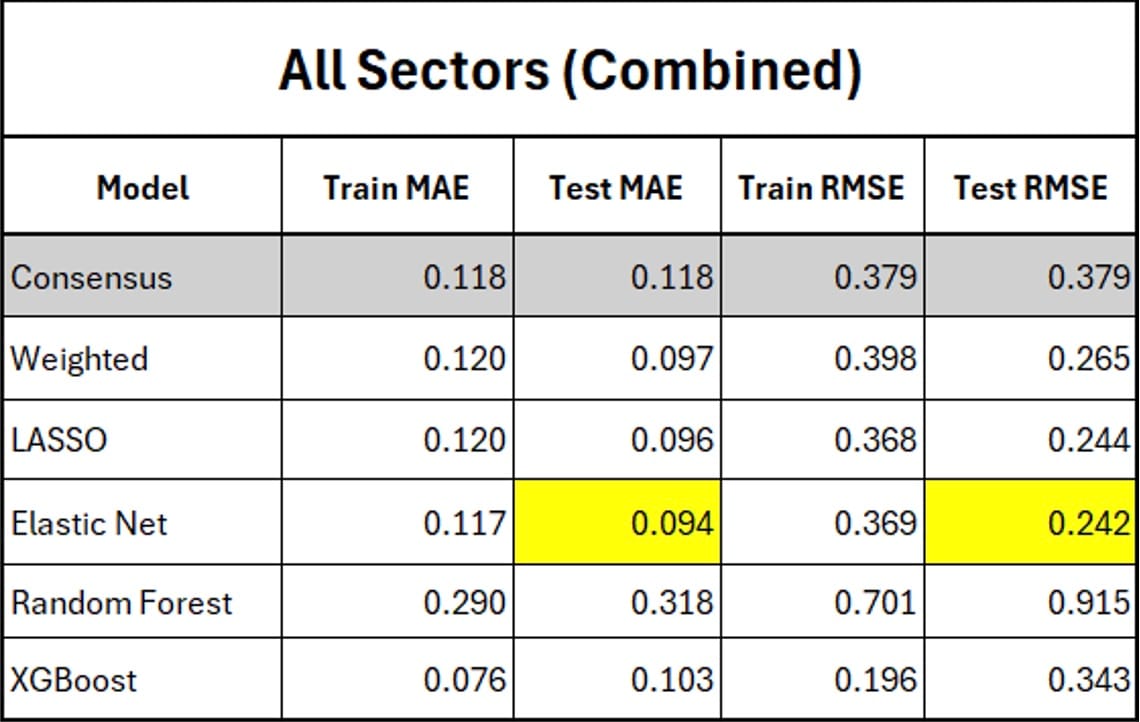
In the combined test sample, Elastic Net reduced MAE by about 20% and RMSE by about 36% compared with analyst consensus. MAE fell from 0.118 to 0.094, and RMSE fell from 0.379 to 0.242. XGBoost had the lowest training errors, but its test errors exceeded Elastic Net’s on both measures. The difference matters because the goal is to forecast earnings for observations the model has yet to see.
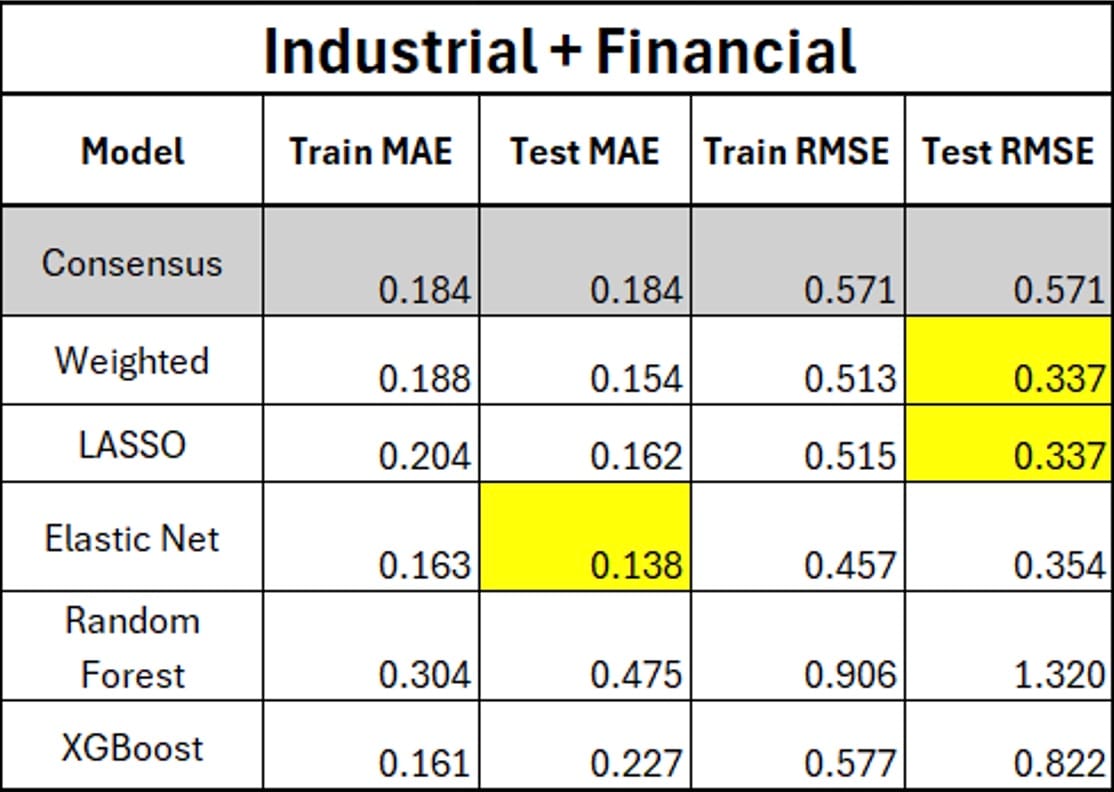
In the industrial and financial grouping, Elastic Net had the lowest test MAE at 0.138. The weighted forecast and LASSO tied for the lowest test RMSE at 0.337. The models therefore rank differently depending on whether accuracy is judged by average absolute error or by a measure that puts more weight on larger misses.
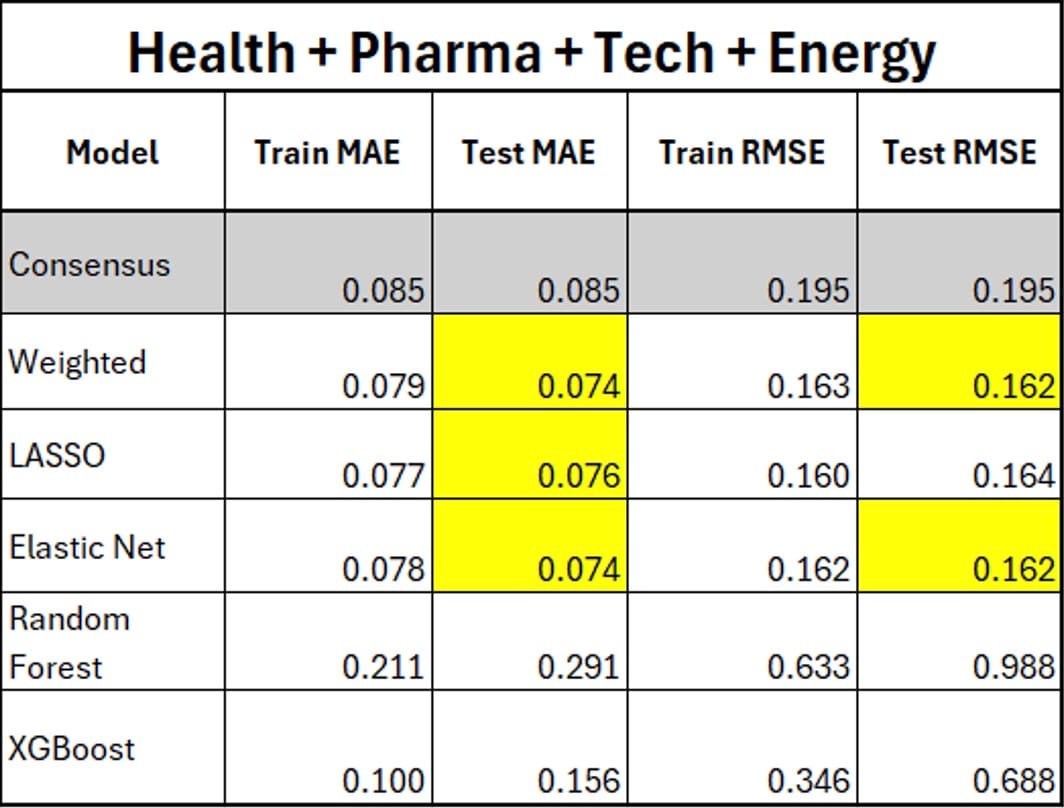
In the health, pharmaceutical, technology, and energy grouping, the weighted forecast matched Elastic Net on both test measures at the precision shown. Both reached a test MAE of 0.074 and a test RMSE of 0.162.
Conclusion
Reweighting analyst information improved on the consensus benchmark in the combined test sample. Elastic Net led overall, while the sector results show why it is worth evaluating models on the companies being forecast and on the error measure that matters for the application.