Researchers: Zelin Chen and Shrijani Chakroborty
Faculty Advisor: Dr. Ionut Florescu
Introduction
A borrower’s credit risk can depend on both the loan application and the economy in which the loan was issued. This project tests whether adding macroeconomic context improves loan-default prediction and whether a large language model can make effective use of that context.
Methodology
The researchers paired LendingClub loan records with macroeconomic data from FRED. They compared XGBoost models trained on structured applicant data with fine-tuned language models trained on text representations of the same records. Both approaches were tested with applicant information alone and with macroeconomic context added. The study also used SHAP scores to examine which features contributed most to XGBoost’s predictions.
Results & Analysis
Adding macroeconomic context modestly improved XGBoost’s ability to rank default risk, raising AUC-ROC from 0.7105 to 0.7176. The classification threshold had a much larger effect on which loans were flagged. In the applicant-plus-macro model, lowering the threshold from 0.50 to 0.30 raised recall from 66.37% to 93.12%, while precision fell from 34.45% to 25.92%. The lower threshold caught more defaults and generated more false positives.

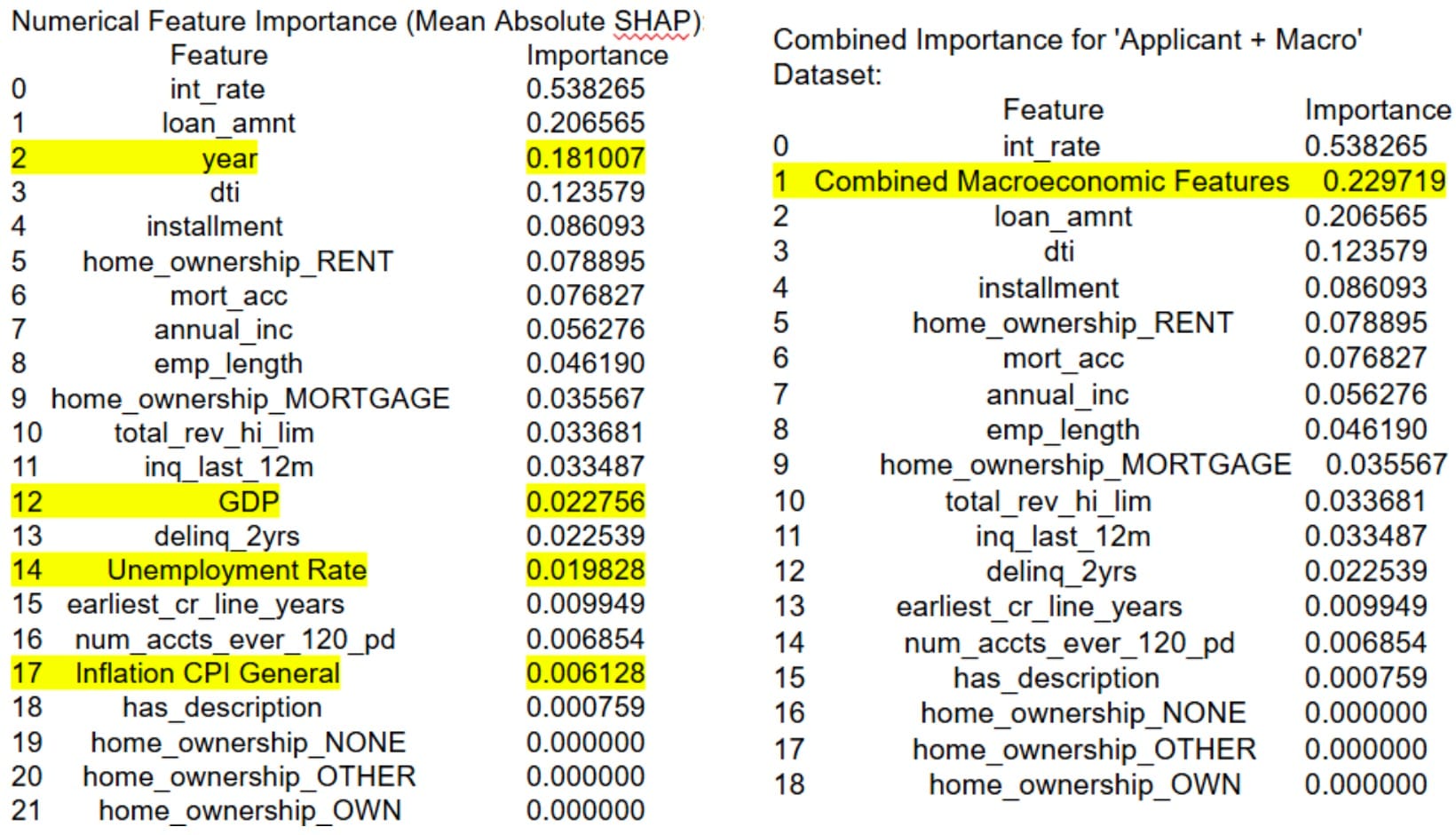
Figure 6 shows that interest rate had the highest individual importance score. When year, GDP, unemployment, and inflation were grouped, their combined importance ranked second. That grouping helps show how much the model relied on economic context across several inputs. The importance scores describe the model’s predictions and do not establish that those variables caused defaults.
Conclusion
Structured applicant data provided the stronger modeling approach in this study, with macroeconomic inputs adding a modest improvement in risk ranking. The language-model experiments had very low precision even when recall was high. The results also show why threshold choice matters when a screening process has to balance missed defaults against false alerts.