Who can apply
- Open globally to accredited universities
- Undergraduate + graduate students
- Cross-university teams allowed
2027 Stevens Institute of Technology School of Business
A global algorithmic trading competition where students design, code, and deploy high-frequency trading strategies in a simulated exchange built on the SHIFT platform.
RequiredPython + GitHub skills. All team members must know Python and GitHub.
51 universities competed in HFTC-25 and HFTC-26
The technology behind HFTC
A market simulator developed in a research lab and used for teaching, research and competition.
SHIFT (the Stevens High Frequency Trading Market Simulation System) has been developed at the Hanlon Financial Systems Center since 2014. It emulates the essential parts of an electronic exchange: a matching engine, a limit order book for every ticker and a brokerage layer.
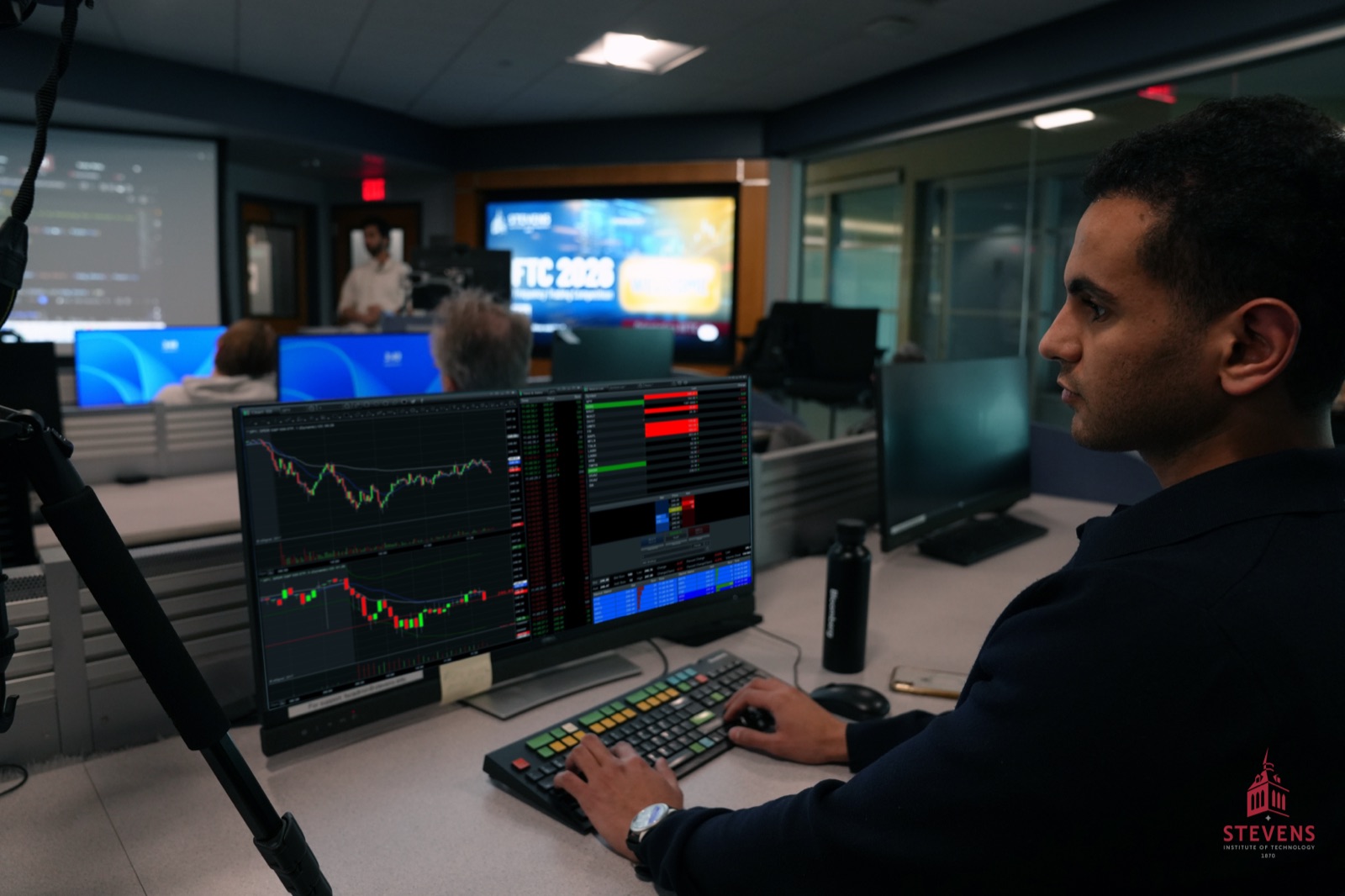
Connect to the SHIFT exchange through a Python interface (a C++ API is also available). Submit market and limit orders, query positions, and stream real-time order-book data.
A real limit order book for every ticker, with price-time priority. Your orders meet replayed market data along with zero-intelligence and reinforcement-learning agents, so fills depend on timing, spread and available volume. Fees and rebates apply, as they do on an exchange.
Algorithms are ranked by P&L in weekly rounds under an F-1-style scoring system. Points rise toward later rounds, the best Sharpe ratio earns a bonus, and each team must make at least 200 trades per day.
Stevens School of Business
The Stevens HFTC is a global competition for undergraduate and graduate students. Teams design and run algorithmic strategies on the SHIFT high-frequency simulation platform, which has a limit order book, price-time priority and asynchronous order flow.
Market making, momentum, stat arb and microstructure-aware execution on the SHIFT simulator.
Show applied engineering and finance skills using Python, GitHub workflows and the FIX protocol.
Experience you can point to on a resume or graduate application.
What you gain
What teams get from competing.
Participant voices
In their own words: what HFTC-26 teams told us they hoped to learn when they applied.
There are not many free HFT simulators online so this competition is the perfect bridge to not only gain experience, but also learn what it takes to develop a winning strategy.
…real insight into how trades influence market dynamics in real time, something almost impossible without working professionally in trading.
More than optimizing performance, we’re interested in learning how to reason through trade-offs, adapt quickly, and make disciplined decisions in an environment that rewards clarity over cleverness.
Competition rules
The rules in brief.
| Trading Assets | Dow Jones 30 or synthetic tickers |
|---|---|
| Trading Scope | Intraday only |
| Initial Capital | $1,000,000 (reset daily) |
| Execution | Fees + rebates apply |
| Platform | SHIFT Python API virtual machine |
| Scoring | Ranked by P&L, F-1-style points, Sharpe ratio bonus |
| Minimum Activity | 200 trades per day |
Who can compete
Awards
Awards for the top five teams, presented after the final trading period and scoring review.

Total prize pool
$4,800
Shared among the top five teams
011st Place
$1,800
022nd Place
$1,200
033rd Place
$900
044th Place
$600
055th Place
$300
Get started
Apply by February 15, complete a technical assessment, and hear back by March 3. No application fee. Selected teams register for $250 per team by March 8.
Application form
Apply through the online form.
Applications are due February 15, 2027.
Questions? Email algotrading@stevens.edu.
Timeline
Key dates from application through the award ceremony.
HFTC Archives
Past Stevens high frequency trading competitions: their teams, faculty, industry partners, winning strategies and moments from each event.