Researcher: Malea McMurray
Introduction
An earnings call reveals both what executives say and how they deliver it. This project examines whether features from transcripts and audio are associated with stock returns or volatility in the three days after an earnings call.
Methodology
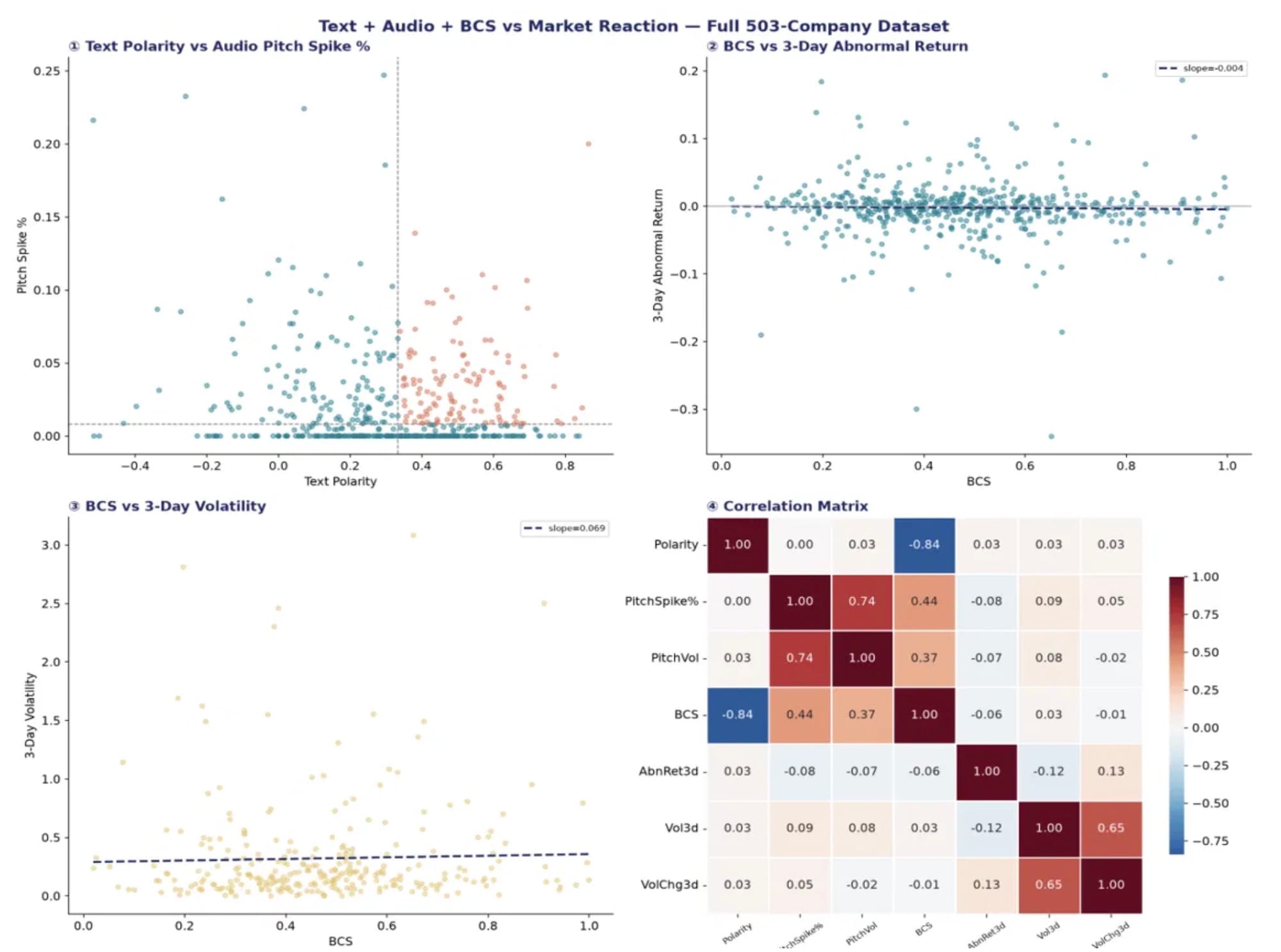
The analysis compares transcript sentiment, measured as text polarity, with voice features such as the share of pitch spikes and variation in pitch. Across a dataset covering 503 companies, it examines how those features and the study’s composite score, labeled BCS in the figure, relate to three-day abnormal returns and volatility.
Results & Analysis
The composite score showed little linear association with three-day abnormal returns or volatility in the full sample. Its correlations were −0.06 with abnormal returns and 0.03 with volatility. Text polarity and the share of pitch spikes also had a near-zero correlation, indicating that the two measures captured different aspects of the calls in this dataset.
Conclusion
Transcript and audio features offer two ways to characterize how executives communicate during earnings calls. In the full sample, the composite score had only a weak linear relationship with the short-term market outcomes shown.